

What are the common materials for indoor Windows?
During the process of home decoration, doors and Windows are indispensable. Almost every household has doors and Windows, and each type of door and window has a different style and function. Take indoor doors and Windows for example, there are many types of materials. Many people are not particularly familiar with indoor Windows. So, what are the common materials for indoor Windows? How are indoor Windows installed?
What are the common materials for indoor Windows
At present, indoor Windows on the market can be classified by material into several types, such as aluminum alloy Windows, wooden Windows, aluminum-wood Windows, thermal break Windows, steel Windows, plastic-steel Windows, color steel Windows, PVC plastic ester Windows, etc. Windows made of different materials have their own characteristics. Let's take a look at the following introduction:
1. Aluminum alloy window
Among the types of doors and Windows, aluminum alloy Windows are currently the most widely used material. Their advantages are very obvious: light weight, strong, not easy to deform, metallic texture, easy to process, and can be surface treated by spraying or electrophoresis. They can be freely color-matched with the building shape and interior space of the room, making them the most chosen material for building doors and Windows.
2. Wooden window
Wooden Windows are the earliest window material used by humans. They have the characteristics of being natural, harmonious, warm and solid. They need to be made of high-quality wood and with excellent craftsmanship, so they are relatively expensive and are mostly used for the treatment of high-end Spaces such as villas. Inferior wooden Windows, on the other hand, are prone to deformation, which affects their use and has no advantages at all.
3. Aluminum-wood window
It is composed of aluminum alloy and wooden Windows, taking the advantages of both. Usually, the wooden window is on the inside, which reflects a natural, warm and high-end look. The aluminum alloy window is wrapped on the outside for better waterproofing. The spray color matches the building. Aluminum-wood Windows require high-quality wood and have a relatively complex process, with a higher price. If they do not meet the quality standards, they may develop cracks over time, and in severe cases, they may deform, affecting their use.
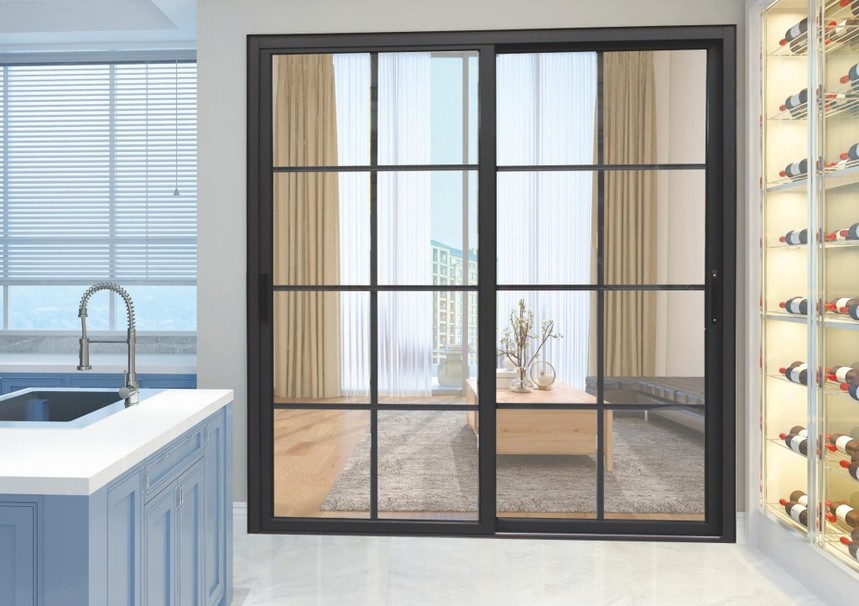
4. Broken bridge insulated window
The upgraded version of aluminum alloy Windows works on the principle of separating the aluminum alloy window profiles through PVC thermal break strips to reduce the thermal conductivity of the aluminum alloy profiles, thereby enhancing the window's heat insulation and achieving energy-saving effects.
5. Steel Windows
This type of window was a product of the Industrial Revolution. Before the 1980s, most of the old public housing in our country used this kind of window. It was prone to rust, cheap and not sealed well. It has now been basically phased out. Among the types of doors and Windows, steel Windows are suitable for decoration and are not practical in daily life.
6. Plastic-steel Windows
As the name suggests, a window is made of a combination of plastic and steel as the frame profile. The plastic (PVC) profile is lined with steel inside, which not only achieves insulation but also increases strength and has a relatively low cost. The drawback is that it is prone to aging and discoloration. Moreover, some unscrupulous merchants lower the standards for steel lining or even do not lining it at all, making it difficult to inspect.
7. Color steel window
Among the types of doors and Windows, color steel Windows, which are profiles rolled from color steel plates, can be regarded as an upgraded version of steel Windows and have basically faded out of the market.
8. PVC plastic ester window
PVC plastic ester window is a type of plastic window with higher strength, which does not require steel lining and is a new type of window material.
The above is a brief introduction to the common materials for indoor Windows. We believe that after the above introduction, everyone will have a further understanding and knowledge of indoor Windows. Of course, no matter which material of window is chosen, the next step is to install the indoor window, and during the installation process, the installation quality must be guaranteed. So, how exactly should indoor Windows be installed? Let's take a look at the following introduction together
How to install indoor Windows
I. Preparations for Window Installation:
1. Check whether the window products are qualified
Windows must be inspected and accepted upon arrival at the site. The first step is an appearance check to see if there is any damage or breakage. The second step is size acceptance. Check the dimensions of the four sides of the frame and the squareness and warping of the fan to achieve quality pre-control before installation.
Secondly, inspect the fasteners, hardware, reinforced profiles and metal backing plates, etc., to see if the surface has undergone anti-corrosion treatment. If fixed plates are used for fixation, the thickness of the fixed plates should be greater than or equal to 1.5mm, and the minimum width should be greater than or equal to 15mm. Their surfaces should be galvanized.
2. Inspection of window openings
To ensure that Windows have good airtightness and stability, paying attention to flatness during installation is crucial. To maintain flatness, the key lies in properly handling the window openings. Before installing the Windows, it is necessary to recheck whether the opening dimensions are correct and whether they are horizontal and vertical. Any openings that do not meet the requirements should be dealt with in advance.
3. Methods for removing old Windows:
Many homeowners replace old Windows with new ones. Therefore, the old Windows need to be removed first. The removal of Windows requires great care to prevent damage to the surrounding decoration and walls during the process. Generally speaking, wooden Windows are relatively easy to remove, while plastic-steel Windows and aluminum Windows are more complicated.
First, use a blade to cut the sealant and other materials on the inner side of the window. Then, remove the window frame. If the window is connected to the wall with expansion bolts, you can directly remove the expansion bolts with a screwdriver. If the expansion bolts are rusty, you can break them with an impact drill. If the connection is made by connecting plates, an impact drill can be used directly. If the window frame is difficult to remove, a hacksaw should be used to saw the middle part of the frame against the wall and take it off.
Ii. Steps for Installing Indoor Windows:
1. Measure dimensions
When using aluminum alloy Windows, before sealing the balcony, the dimensions of the balcony sealing surface should be accurately measured. The window frames and glass should be processed and manufactured according to the dimensions outside the construction site and transported to the construction site. Before installation, it is necessary to check whether the window dimensions are consistent with the dimensions of the balcony sealing openings.
2. Fixed bracket
(1) Fix with a fixing plate:
Before installing the window, the base layer of the balcony opening should be cleaned first. It is required to remove the base material of the window close to the wall and drill holes at the fixed points. Pre-set expansion bolts or plastic expansion pins to fix the window frame. When installing the window, first firmly sit the window at the opening, fix its position, and then fix it with screws and plastic expansion pins.
(2) Fix with expansion bolts:
Under normal circumstances, the bolts need to be 10 centimeters long. If some holes are driven off course, they can be smoothed out by applying cement, etc. The bolts need to be 12 centimeters long to be directly fixed to the original cement pouring layer of the wall, so that the window frame can be stable. You can tap it with your hand. If you find that the wall around the window frame is hollow, you need to drive it deeper.
3. Check if it is properly aligned
After the window frame is connected to the window opening, it is necessary to check whether the window is installed correctly. If the window is not installed properly, it may become more and more crooked after a period of use. If it is a regular rectangular window, you can directly measure the diagonal lines of the window (the lower left corner and the upper right corner, the upper left corner and the lower right corner), and the lengths of the two lines should be consistent. If it is an arc-shaped window, a level should be used. A bubble in the middle of the level indicates that the window is straight. If it is a tilted window, a hanging hammer needs to be used.
4. Apply foam sealant
After the window adjustment is completed, it is necessary to apply foam sealant to fill the gap between the window frame and the wall. Once the foam sealant has cured (usually taking 2 to 3 hours, and it takes longer in winter), cut off the excess foam sealant.
5. Install window sashes and other accessories
After fixing the window frame, the next step is to install the window sash and other accessories. Be careful during the installation.
6. Apply sealant
After applying the foam sealant, evenly spread the sealant around the window frame to prevent rainwater from seeping into the room through the installation gaps between the window and the wall.